Operating Parameters
| Material | Coal |
| Capacity | 1,500 TPH |
| Belt Speed | 2.4 m/s |
| Moisture Content | 0% (Dry Condition) |
| Bulk Density | 758.112 kg/m³ |
| Analysis Method | DEM Simulation |
Problem Statement
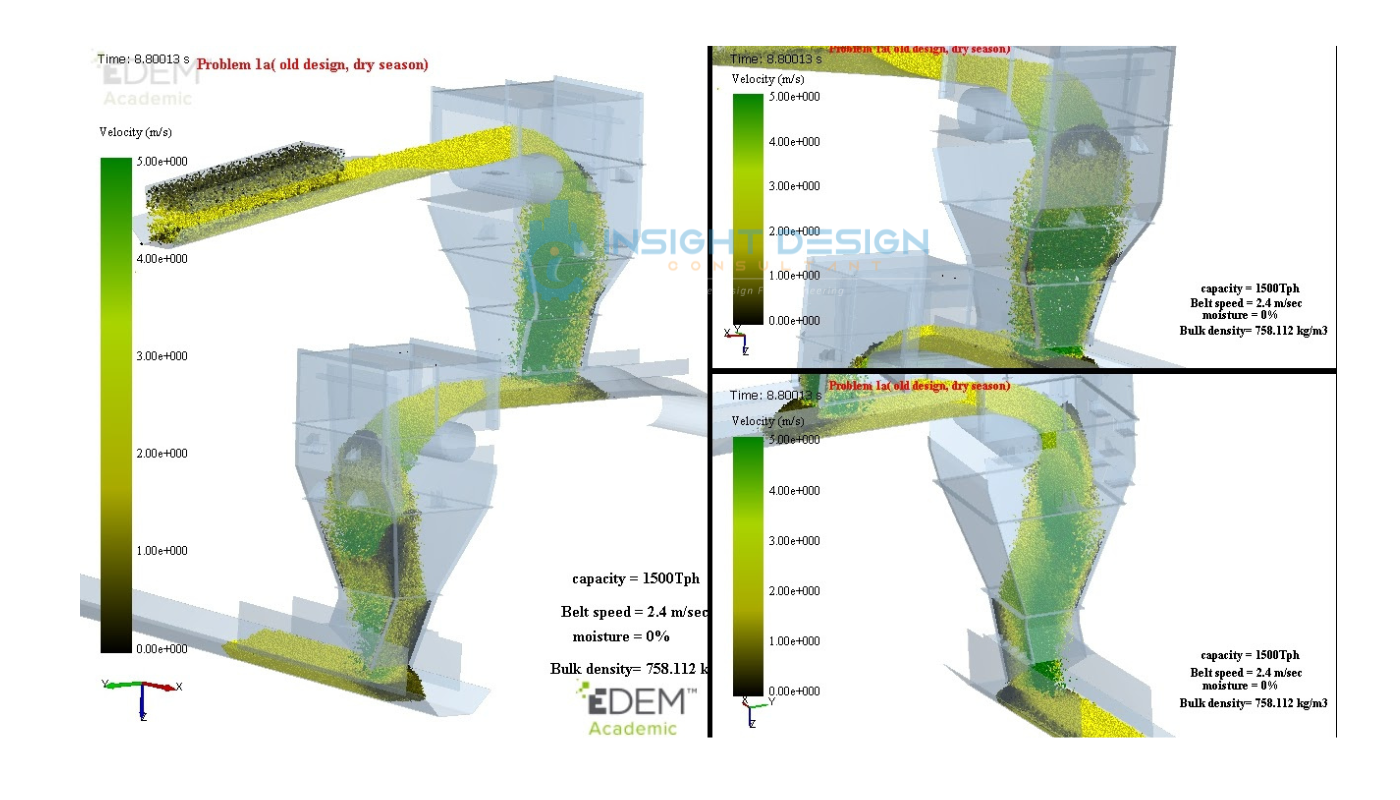
The existing chute design was experiencing operational concerns. The DEM simulation was conducted to visualize particle movement and identify critical problem areas.
DEM Observations
Abrupt Change in Material Direction
High particle impact forces with significant energy loss. Material stream enters at high velocity and undergoes a sudden direction change, causing particles to strike chute walls before redirection — resulting in increased liner wear and material turbulence.
Material Congestion Zone
Dense accumulation in the central chute section. Reduced flow area creates localized congestion with increased inter-particle collisions. Potential risk of blockage under wet or sticky operating conditions — chute operates with limited flow margin.
High Wear Regions
Velocity contours indicate concentrated impact zones along the upper transition bend, central chute walls, and lower discharge region. Repeated particle impacts result in accelerated liner wear, increased maintenance frequency, and potential structural degradation.
Flow Instability
The particle stream exhibits turbulence throughout the chute — material scattering, velocity fluctuations, random particle rebounds, and increased dust liberation. Absence of controlled material guidance contributes to unstable flow patterns.
Discharge Performance
Material exits with varying velocities and imperfect stream alignment. Loading profile on the receiving conveyor is uneven, resulting in belt wear, material spillage, increased housekeeping requirements, and conveyor mistracking risk.
Velocity Analysis
Particle velocities up to approximately 5 m/s. Maximum velocities occur at the chute entry and impact zones. Energy dissipation through repeated wall impacts rather than controlled flow guidance.
Root Cause Analysis
| Issue | Root Cause |
|---|---|
| High wear | Direct particle-wall impacts |
| Material congestion | Restricted transition geometry |
| Dust generation | Turbulent particle movement |
| Flow instability | Lack of controlled trajectory |
| Uneven belt loading | Poor discharge stream control |
| Maintenance issues | Concentrated wear zones |
Performance Assessment
Recommended Improvements
Controlled Flow Chute Design
Introduce a hood-and-spoon or engineered flow-control chute geometry to minimize direct impact, guide material trajectory, and reduce turbulence throughout the transfer.
Heavy-Duty Wear Protection
Install wear-resistant liners at the entry impact zone, transition section, and discharge region to reduce liner replacement frequency and extend service life.
Increase Flow Area
Optimize the transition geometry to eliminate material compression zones, relieve congestion, and improve flow capacity margin for variable throughput conditions.
Improve Belt Loading Conditions
Redesign the discharge section to match belt velocity, centralize material loading on the belt, and reduce particle bounce and edge spillage at the transfer point.
Dust Reduction Measures
Implement an enclosed chute arrangement with skirt sealing system and reduced free-fall height to contain dust liberation and improve site environmental performance.
Conclusion
The DEM analysis of the existing transfer chute reveals several performance deficiencies associated with the current design. The chute experiences significant particle-wall impacts, localized material congestion, high wear rates, and unstable flow patterns.
While the system can handle the specified 1,500 TPH throughput under dry conditions, it operates with reduced efficiency and elevated maintenance requirements. Redesigning the chute with controlled-flow principles would significantly improve material handling performance by reducing wear, minimizing dust generation, improving conveyor loading, and increasing operational reliability.